
Young soccer players need more than technical ball skills to perform well from the opening whistle to the final minutes of a match, because soccer requires repeated acceleration, deceleration, sprinting, recovery, quick changes of direction, coordination, balance, and decision-making while fatigue gradually increases.
The right soccer conditioning exercises help young athletes improve stamina without relying on endless running, and when conditioning is age-appropriate and progressive, players can improve speed, endurance, movement quality, and confidence while reducing unnecessary training fatigue.
At Team85 Fitness & Wellness, young athletes can access a sports-focused training environment designed to support strength, conditioning, agility, coordination, and overall athletic development.
What Are Soccer Conditioning Exercises?
Soccer conditioning exercises are training activities designed to improve the endurance, speed, agility, recovery capacity, strength, and repeated-sprint ability players need during competitive soccer.
Unlike continuous-distance running, effective youth soccer conditioning reflects the stop-and-start nature of the game, where players frequently accelerate toward the ball, slow down, change direction, recover, defend, attack, and sprint again.
According to ACE Fitness soccer performance guidance, soccer performance benefits from training acceleration, braking, directional movement, strength, and repeated high-intensity efforts rather than relying only on steady-state cardio.
Why Youth Soccer Conditioning Matters
Good conditioning allows players to maintain movement quality and decision-making as a match progresses, especially during repeated attacking runs, defensive recoveries, and high-intensity transitions.
An effective soccer endurance training program should develop:
- Aerobic endurance
- Repeated sprint ability
- Acceleration
- Deceleration
- Agility
- Lower-body strength
- Core stability
- Coordination
This combination makes structured soccer fitness drills more sport-specific than simply asking young athletes to run continuous laps.
7 Soccer Conditioning Exercises for Young Athletes
1. Shuttle Runs for Soccer Endurance Training
Shuttle runs are one of the most effective soccer stamina training exercises because they combine acceleration, turning, braking, and recovery.
Place cones 5 to 10 yards apart and have the athlete accelerate toward one cone, stop under control, change direction, and return.
Young players should first focus on controlled movement and safe deceleration before increasing speed or repetitions.
2. Cone Acceleration Soccer Fitness Drills
Cone acceleration drills help players develop explosive first steps, which are essential when chasing loose balls, closing down opponents, or breaking into open space.
Set several cones approximately 5 to 10 yards apart and encourage the athlete to accelerate quickly while maintaining proper posture and controlled foot placement.
These drills work particularly well alongside structured sports performance training focused on movement mechanics, conditioning, strength, and coordination.
3. Small-Sided Games for Soccer Stamina
Small-sided games such as 3v3 or 4v4 naturally create repeated accelerations, defensive recovery runs, short sprints, changes of direction, and frequent ball interactions.
They are among the best soccer fitness drills because athletes improve conditioning while still practicing decision-making and technical skills.
4. Dribble-and-Recover Conditioning Drill
Have the player dribble toward a target cone, complete a controlled pass or shot, jog back to the starting point, and repeat.
This creates a practical combination of soccer endurance training and ball control because players must maintain technical quality while gradually becoming tired.
5. T-Drill for Soccer Speed and Agility
The T-drill develops forward acceleration, lateral movement, backward movement, and controlled changes of direction.
Among common soccer speed and agility drills, the T-drill is useful because it challenges several movement patterns within one exercise.
Players should learn proper braking mechanics before attempting the drill at maximum speed.
6. Repeat Sprint Soccer Stamina Training
Short repeated sprints followed by controlled recovery periods can help players develop the ability to reproduce explosive efforts during a match.
For example, athletes can complete short 10-to-20-yard sprints, recover briefly, and repeat several technically sound efforts.
For broader youth training guidance, parents and coaches can also review the American Academy of Pediatrics recommendations for strength and resistance training.
7. Reaction-Based Soccer Agility Drills
Reaction drills help players move beyond predictable cone patterns.
A coach can place several colored cones around an athlete and call out a color, forcing the player to react quickly and accelerate toward the correct target.
These exercises combine agility, coordination, reaction time, and decision-making, making them valuable for game-related athletic development.
Soccer Conditioning Exercises Comparison
| Exercise | Main Benefit | Secondary Benefit |
| Shuttle Runs | Stamina | Deceleration |
| Cone Acceleration | Speed | Running Mechanics |
| Small-Sided Games | Endurance | Ball Skills |
| Dribble and Recover | Conditioning | Ball Control |
| T-Drill | Agility | Coordination |
| Repeat Sprints | Sprint Endurance | Speed |
| Reaction Drills | Agility | Decision-Making |
Soccer Conditioning by Age Group
Soccer Conditioning for Ages 6–9
Young players should focus primarily on fun movement, coordination, balance, running mechanics, short reaction games, and basic ball activities rather than demanding conditioning sessions.
Youth Soccer Conditioning for Ages 10–13
Athletes can begin using short shuttle runs, acceleration drills, agility exercises, small-sided games, and moderate conditioning intervals.
Soccer Fitness Training for Ages 14–17
More developed athletes can gradually include structured intervals, repeat sprints, strength training, multidirectional agility work, and more advanced soccer stamina training.
Parents looking for year-round athletic development can also explore Team85’s fitness and training facilities.
Indoor Soccer Conditioning for Year-Round Training
Weather can make consistent outdoor training difficult, particularly during colder New Jersey winters, summer heat, rain, or poor field conditions.
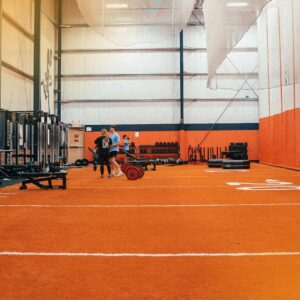
Indoor turf allows athletes to continue working on sprinting, agility, reaction exercises, ball control, and conditioning throughout different seasons.
Team85’s Field House provides indoor and outdoor sports spaces that can support youth athletic training and soccer-related activities.
Soccer Conditioning for Burlington County Athletes
Burlington County combines suburban communities, recreational parks, schools, youth sports organizations, and easy access to major Central and South Jersey transportation routes.
Because local athletes experience hot summers, colder winters, rainfall, and changing seasonal conditions, year-round access to structured athletic facilities can help maintain training consistency.
Families seeking youth soccer conditioning in Burlington County can use Team85’s Bordentown location for conditioning, athletic development, turf activities, speed work, and agility training.
Soccer Fitness Training Near Monmouth County
Monmouth County includes active suburban communities as well as areas closer to the Jersey Shore, where soccer and other youth sports remain popular throughout the year.
Changing coastal and inland weather conditions can occasionally interrupt outdoor practices, making structured indoor athletic environments particularly useful during colder or wetter periods.
Young athletes traveling from Monmouth County can use Team85 for strength, conditioning, speed, agility, and general sports-performance development.
Youth Soccer Conditioning Near Bucks County, PA
Bucks County sits across the Delaware River from New Jersey and includes historic towns, suburban neighborhoods, recreational facilities, and active youth sports communities.
Athletes experience humid summers, cold winters, rain, and changing seasonal conditions, which can make year-round outdoor conditioning less predictable.
Team85 provides another nearby option for families seeking structured soccer endurance training, speed development, agility work, and youth athletic conditioning.
Soccer Speed and Agility Training Near Mercer County
Mercer County includes communities such as Trenton, Hamilton, Princeton, Lawrence, and West Windsor, with strong participation in school, recreational, and competitive youth sports.
Seasonal temperature changes and rain can affect outdoor training schedules, so athletes can benefit from access to dedicated fitness and turf environments.
Young soccer players can use structured conditioning to develop speed, movement efficiency, stamina, coordination, and confidence alongside their normal team practices.
Build Soccer Stamina With Smarter Conditioning
The best soccer conditioning exercises do more than make young athletes tired because effective training should help players accelerate faster, recover more efficiently, move with better control, and maintain quality performance later in matches.
Shuttle runs, small-sided games, repeat sprints, reaction exercises, agility drills, and ball-based conditioning can all contribute when training volume matches the athlete’s age and current development level.
Families looking for structured athletic development can explore the Team85 Fitness Center and available youth performance programs in Bordentown, New Jersey.
FAQs About Soccer Conditioning Exercises
What are the best soccer conditioning exercises for youth players?
How can soccer players build stamina?
What are the best soccer fitness drills?
Are shuttle runs good for soccer?
How often should youth soccer players condition?
What are good soccer speed and agility drills?
Is long-distance running good for soccer?
How can kids improve soccer endurance?
Can soccer conditioning be done indoors?
How do soccer players improve speed and stamina together?
What is a good soccer conditioning workout for a 12-year-old?
Do soccer agility drills improve stamina?
Where can young athletes train for soccer near Bordentown, NJ?